
Understand hand function
Advance research together
Functional suitability
Focus on hand function
Neurological and neuromuscular impairments affecting hand motor function are relevant. Diagnosis alone does not determine suitability: we consider the individual functional profile.
Active hand movement
Which finger movements remain possible? Which grasping movements does the person want to perform, and which activities require support?
Residual muscle signals
We examine forearm muscle activity during attempted movement. Whether these signals can support control is measured and tested individually.
Passive range of motion
How freely can the fingers be moved passively? Finger stiffness and tendon shortening may complicate testing. Let’s assess any existing restrictions together.
Arm mobility
The neuroorthosis supports hand function. Everyday use requires sufficient mobility and active function of the wrist, elbow and shoulder. Testing for therapy purposes may also be considered without these prerequisites.
These points support an initial discussion. They are not a definitive list of study inclusion or exclusion criteria.
Scientific foundations
What is being studied and what can it tell us?
GRASPAGAIN research distinguishes between muscle-signal measurement, recognition of movement intentions and practical use of the orthosis.
Measure signals
Research examines which residual muscle activity can be recorded during attempted movements of the affected limb.
Recognise movement intentions
A further question is which hand movements can be distinguished from the recorded signals and used for control.
Evaluate practical use
Testing with the neuroorthosis focuses on usability, control and tasks involving everyday objects.
We aim to demonstrate how GRASPAGAIN can benefit everyday life and therapy. Alongside muscle signal recording and orthosis control, we therefore also investigate its practical application.
Our science page presents the current status and results to date.
Study framework
Positive ethics approval for the ongoing study
The ongoing study at FAU Erlangen-Nürnberg has received positive ethics approval.
The approval applies to this study and does not constitute evidence of efficacy. The public study description explains its aims, procedure and participation requirements. We discuss specific collaboration questions directly.
Collaboration
We are looking for clinical collaborators

Do you work in a hospital, rehabilitation centre or therapy practice? Let’s discuss how your experience could contribute to further research.
- Suggest potential participants
- Discuss whether referral to the ongoing study might be appropriate. Individual suitability and participation requirements are assessed subsequently.
- Contribute clinical experience
- Which tasks matter to your patients? What requirements arise from therapy and everyday life? We would like to incorporate this perspective together.
- Discuss joint projects
- Do you have a specific research question or an idea for joint testing? We discuss aims, feasibility and requirements individually.
For the initial enquiry, your institution, clinical field and collaboration interests are sufficient. Please do not include identifiable patient data at this stage.
Contact
Medical questions
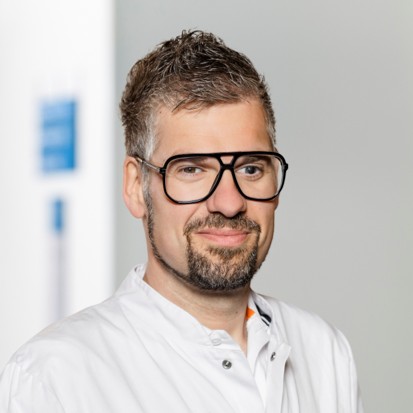
Dr. med. Matthias Ponfick
Medical Advisory Board
Head of the Spinal Cord Injury Centre in Rummelsberg. He supports GRASPAGAIN as medical advisor.
Get in touchFAQ
Questions from clinical practice
Our focus is on neurological and neuromuscular impairments of hand motor function. We consider function, muscle signals and mobility together. Participation in a specific study also depends on its participation requirements.
There is no universal answer. It depends on the individual. Let’s discuss the extent of the finger stiffness or tendon shortening and whether testing could be an option.
GRASPAGAIN is under development. This page focuses on studies and clinical collaboration. An enquiry does not guarantee routine provision or study participation.
Your next step
Bring your clinical perspective
Whether you have an initial question or a concrete project idea, we welcome discussions with physicians and therapists.